Influence has always been a very powerful weapon—shaping decisions, alliances, and the course of history without a single shot fired. This executive course trains students to master the strategic art of influence in today’s interconnected battlespace—where narratives, perceptions, and information define victory. Students learn to plan and execute influence campaigns, dissect and counter malign operations, and apply asymmetric thinking rooted in psychology, history, and strategy. From boardrooms to battlefields, graduates leave with the tradecraft to ethically sway behavior, build resilience, and lead with precision in environments where information itself is the arena of power.
What was only given to Special Forces, Special Operations, key leaders throughout the intelligence community, and international officers from Algeria to Somalia to the Ukraine to Estonia to India to the Philippines to Japan. Is now being offered here. For the first time in history. Unclassified. Finally.
Only here. Nowhere else is influence taught at the grand strategic global level as a singular scholarly discipline.
Professionals in:
-
Intelligence, Defense & Policy
-
Media & Marketing
-
Technology
-
Corporate Strategy & Business Intelligence
1. The Art and Strategy of Influence
-
Introduces powerful mental models and frameworks to elevate your strategic thinking and leadership.
-
Four millennia of influence lessons reimagined for the AI era.
-
Draws from neurobiology, anthropology, linguistics, history, and the timeless art of storytelling.
-
Applications: Develop influence campaigns across government, corporate, civilization, and community to measurably affect people’s behavior and decision-making with prejudice- indirectly, distantly, silently, and invisibly.
2. Deception Warfare and Disinformation
-
We will follow disinformation campaigns from surgical target analysis through measures of impact. Step-by-step. Especially that the best deception campaigns amplify self-deception.
-
Applications: From this study, we will be able to cause the collapse of disinformation campaigns under their own weight. Avoid whack-a-mole defensiveness—countering disinformation often amplifies the original disinformation.
3. Influence Tradecraft and Subconscious Targeting
-
No more guesswork. No platitudes and theories disjointed from how influence actually succeeds. Leverage the latest findings in neurobiology on subconscious and limbic-system processes to surgically target audiences with measurable impact.
-
Applications: Frameworks to amplify/dampen native narratives. Enable/disable native networks. With stealth and subtlety—indirect and insensible.
4. Substantial Governance
-
Recognize and analyze the true quiet influencers in any society and community and corporate reach. Often without formal title or online splash. From leaders of grey markets, unions, clans, tribes, hollers, slums, secretarial pools, cartels, protection rackets, educators, religious sects, etc.
-
Applications: When appropriate understand and ethically leverage whole-of-society, whole-of-nation, transnational influence ebbs and flows.
5. Total War and Influence
-
Power lies in the physical and the psychological. But even behind the physical lies the psychological. A will to fight, kill, die. And a will of a nation to suffer decades. In total war, those influenced with the more sacred of values have a rare advantage to survive an invasion despite the original balance of lethal force.
-
Also, during the final throes of absolute war, all sides turn to influence tradecraft. Because it is practical. Because it works. Because it’s cheap. And because it can be far more lethal than missiles and guns.
-
Applications: Uncover and unleash your team with uncommon unity, dedication, and transcendent narratives.
Questions? Contact Dr. Clark at: HGClark@theacademy.university

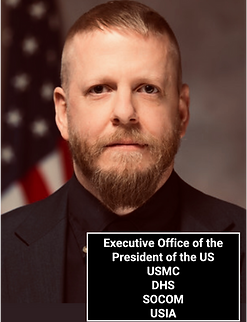
Dr. Howard Gambrill Clark

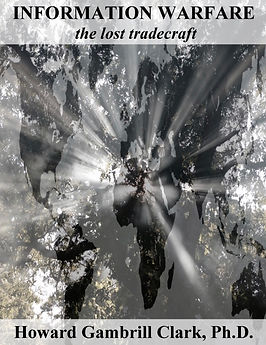
Professor Gambrill Clark has specialized in influence strategies and psychological warfare for 27 years. He graduated from Yale University with a degree in international relations focusing on the Middle East. While a student, Dr. Clark was a writer for U.S. Information Agency's Middle East / South Asia Division; served on the staff of the Senate Defense Appropriations Subcommittee; and studied Arabic at the American University in Cairo via a Department of Defense grant. After Yale, Dr. Clark served as policy analyst in the Executive Office of the President for the President’s Chief Economic Adviser, focusing on counterterrorism. Following the White House, Dr. Clark served in the U.S. Marine Corps as an intelligence officer and multi-national / special-unit commander with multiple deployments to Iraq as well as Afghanistan and the Philippines. After military service, Dr. Clark was presidentially appointed as Department of Homeland Security Chief Intelligence Officer's Special Assistant. Then, as Senior Intelligence Analyst for Homeland Security Counter-Radicalization, Dr. Clark helped lead the Intelligence Community in intelligence support to countering violent extremism. He was then promoted to Senior Intelligence Officer for Homeland Security Operations Intelligence (headquarters) before acting as consultant (contracted Senior Intelligence Analyst) to Special Operations Command's Counter-Radicalization Branch. While earning his Ph.D. from King's College London War Studies, he served as senior counter-violent-extremism adviser and trainer for USAID, USSOCOM, USDA, DOS, Special Forces, USMC, NATO, and partner governments in southwest Asia and Associate Fellow at the International Centre for the Study of Radicalisation. Recent positions includes: CEO, Stability Institute (non-profit) - training and advising special operators and stabilization professionals on defeating extremist groups throughout five continents. Faculty, National Defense College (UAE) - director and coordinator for 'Countering-Violent-Extremism,' 'Information and Cyberwarfare,' 'Media and National Security,' and 'International Security' programs (sponsored by the U.S. National Defense University) Lecturer, Civil and Political School (Ukraine) He is now the president of Narrative Strategies, where he teaches and researches the fields of strategic influence, psychological warfare, counterterrorism, and countering violent extremism. He is also an associate professor of influence strategy and psychological warfare in Washington, DC. Select books / theses: Influence Warfare Volume I: A Blueprint, Narrative Strategies Ink, Washington, DC, 2021 Information Warfare: The Lost Tradecraft, Narrative Strategies, LLC, Washington, DC, 2017 Information as an Instrument of State Power: A Primer, UAE National Defense College, UAE General Headquarters, 2017 Countering Violent Extremism: A Primer, UAE National Defense College, UAE General Headquarters, 2017 Defeating Violent Extremists: The Tradecraft, UAE National Defense College, UAE General Headquarters, 2016 Village Stability Operations, U.S. Army Peacekeeping & Stability Operations Institute, 2015 (coauthor) Lions of Marjah: Why Marjah’s Militia Combats Violent Extremists, King’s College London thesis, 2014 Revolt Against Al-Qa`ida: A Strategy to Empower Muslims and Collapse International Insurgency, Light of New Orleans Publishing, New Orleans, 2010 Narrative Analysis: Taliban, Special Operations Command, Tampa, 2010 (coauthor) Kill Al Qaeda, Light of New Orleans Publishing, New Orleans, 2009 Select articles and chapters: "War and Narrative," chapter in Dangerous Narratives: Warfare, Strategy, Statecraft, Narrative Strategies Ink, 2020. "How to Teach Influence: Thoughts on a New Discipline," article in Teaching Public Diplomacy and the Information Instruments of Power in a Complex Media Environment, National War College and U.S. Advisory Commission on Public Diplomacy, Washington, DC 2020. “Money and Stabilization,” National Defense Journal, National Defense College, UAE, June 2017 “The Responsibility to Protect in the Context of State-Sponsored Terror,” Defense and Intelligence Norway,” July 2016 (coauthor) “Go Local,” American Interest, July/August 2015 “Regimental Effects Operations Center: Enhancing Situational Awareness and Achieving Unity of Effort in Nonkinetics,” The Marine Corps Gazette, Volume 96, Issue 8, 2012 (supporting author) “Ending Al Qaeda,” American Interest, Volume 6, Number 6, July/August 2011 (coauthor) “The Accidental Ideologue,” Jane's Terrorism and Security Monitor, 2010 Twenty-eight classified or official-use-only cross-Intelligence-Community strategic assessments on countering al-Qa`ida for cabinet-level leaders and White House, 2007 – 2009 Three National Economic Council damage assessments for potential biological terrorist attacks, 2001 Six articles on Middle East leadership and Iraqi resistance for Department of State, 1999.