
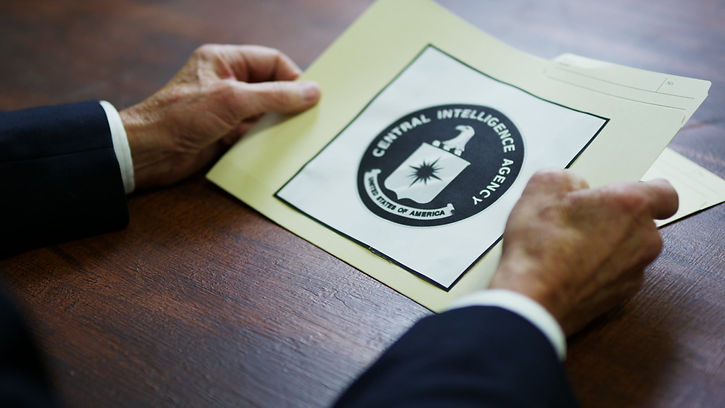
Enter the world of professional intelligence and learn how information becomes insight, warning, and decision advantage.
The Executive Certificate in Intelligence Analysis & Production takes students through the complete intelligence process—from human-centered and technical collection to multi-intelligence fusion, structured analysis, intelligence writing, and executive-level briefing. Students will explore how the U.S. Intelligence Community uses HUMINT, OSINT, SIGINT, GEOINT, MASINT, cyber intelligence, and other collection disciplines to understand complex events and emerging threats.
Students will learn to evaluate sources, detect information gaps and circular reporting, uncover hidden assumptions, challenge conventional judgments, identify patterns, and construct alternative futures. They will then transform their findings into concise intelligence briefs and defensible long-form assessments using the standards of clarity, precision, probability, and confidence expected in professional intelligence environments.
The program culminates in a capstone intelligence briefing in which students present and defend their principal judgments before a decision-making audience. Graduates leave with more than an understanding of intelligence—they develop the analytical discipline and communication skills required to produce intelligence that informs consequential decisions.
KEY DETAILS
Who Will Benefit:
-
Intelligence, Defense & Policy
-
National Security
-
Private Sector & Business Intelligence
Where:
Live-Online (Synchronous)
Duration:
4 Weeks, 8 Modules, 3 Credits
When:
Spring (April 2027)
Tuition:
$2,550
Stand Out in a Competitive Intelligence Career Field:
Develop a comprehensive understanding of how the U.S. Intelligence Community collects, evaluates, analyzes, and communicates intelligence. Unlike programs focused on only one part of the field, this certificate connects human-centered collection, technical intelligence disciplines, multi-INT fusion, structured analytic techniques, intelligence writing, and executive briefing—allowing students to understand how the entire intelligence process works from collection to decision-making.
Students will also have the opportunity to complete a written Intelligence Assessment that can serve as a professional work sample for future job applications and interviews.
Program Key Takeaways:
* Understand the Intelligence Process — Learn how intelligence requirements, collection, processing, analysis, production, and dissemination work together to support national security and high-level decision-making. * Integrate Multiple Intelligence Disciplines — Understand the capabilities and limitations of HUMINT, SIGINT, GEOINT, MASINT, and OSINT—and how information from multiple sources is fused into a more complete intelligence picture. * Think and Assess Like an Intelligence Analyst — Evaluate complex information, identify patterns, challenge assumptions, recognize bias and deception, test competing explanations, and develop clear, defensible judgments. * Produce Decision-Ready Intelligence — Transform fragmented information into professional intelligence assessments that communicate key judgments, supporting evidence, confidence levels, implications, and decision advantage. * Anticipate and Communicate What Matters — Develop skills in warning, forecasting, and briefing so decision-makers understand not only what is happening, but what may happen next and why it matters.
COURSE OVERVIEW
MODULE 1 — THE INTELLIGENCE COMMUNITY, INTELLIGENCE PROCESS & HUMAN-CENTERED COLLECTION Discover how the U.S. Intelligence Community transforms information into intelligence for national security decision-makers. Students will examine the roles of major intelligence agencies, the intelligence cycle, and the use of HUMINT and OSINT to collect and evaluate information from people, public records, media, and digital sources. MODULE 2 — TECHNICAL INTELLIGENCE COLLECTION & MULTI-INT FUSION Explore the advanced collection disciplines that allow intelligence organizations to detect communications, activities, locations, technologies, and emerging threats. Students will examine SIGINT, COMINT, ELINT, FISINT, GEOINT, IMINT, MASINT, and cyber intelligence—and learn how analysts combine multiple INTs to develop a more complete intelligence picture. MODULE 3 — FROM COLLECTION AND PROCESSING TO ANALYSIS Learn how fragmented reporting becomes meaningful, decision-relevant intelligence. Students will practice evaluating sources, identifying information gaps, detecting circular reporting, organizing complex data, and using timelines, matrices, coding, and link analysis to reveal patterns and relationships. MODULE 4 — CRITICAL THINKING & STRUCTURED ANALYTIC TECHNIQUES: DIAGNOSTIC TECHNIQUES Evidence does not interpret itself. Students will use diagnostic structured analytic techniques to examine evidence, uncover hidden assumptions, evaluate competing explanations, and determine what the available information actually supports. MODULE 5 — STRUCTURED ANALYTIC TECHNIQUES: CONTRARIAN & IMAGINATIVE TECHNIQUES Learn how professional analysts challenge conventional thinking and prepare decision-makers for unexpected developments. Through practical exercises, students will apply contrarian and imaginative techniques to test prevailing judgments, identify overlooked possibilities, construct alternative futures, and anticipate what could happen next. MODULE 6 — INTELLIGENCE WRITING & SHORT-FORM PRODUCTION Develop the ability to communicate consequential intelligence under strict time and space constraints. Students will learn to write a powerful BLUF, present key judgments, express probability and confidence accurately, and produce concise intelligence that immediately tells decision-makers what matters and why. MODULE 7 — INTELLIGENCE WRITING & LONG-FORM ASSESSMENT PRODUCTION Transform research and analysis into a professional, decision-ready Intelligence Assessment. Students will learn to integrate evidence, analytical judgments, alternative explanations, confidence levels, implications, and visual intelligence into a clear and defensible long-form product. MODULE 8 — INTELLIGENCE BRIEFING, EXECUTIVE COMMUNICATION & CAPSTONE Bring the full intelligence process together in a professional capstone briefing. Students will present and defend their principal judgments, communicate uncertainty, respond to challenging questions, and deliver intelligence with the clarity, confidence, and precision expected by senior decision-makers.

Dr. Elena Taube Bailey

Dr. Bailey brings a wealth of expertise spanning intelligence, policy, defense, and academia, as well as the nonprofit and private sectors. In academia, Dr. Bailey serves as the President and Program Director of Cyberpsychology at The Academy. Additionally, Dr. Bailey is a professor at the National Defense University’s College of Information and Cyberspace (CIC), where she teaches courses on influence warfare, cyberspace, national security, and strategic communication. She also holds the position of Adjunct Professor at Georgetown University, within the Master of Professional Studies in Applied Intelligence program. Dr. Bailey is the co-founder and CEO of Glocal, the world’s pioneering News Superintelligence platform, combining human collective intelligence and AI to elevate the information environment. Fluent in English, Russian, Ukrainian, and conversational Hebrew, Dr. Bailey resides in the Washington Metropolitan Area with her husband. Counterintelligence & Intelligence: Dr. Bailey served as a senior counterintelligence (CI) specialist at the Department of Defense, Defense Threat Reduction Agency (DTRA), where she focused on CI and worldwide cyber threat analysis. DTRA enables the DoD and the U.S. Government to prepare for and combat WMDs and improvised threats and to ensure nuclear deterrence. The agency’s legacy extends back to the Manhattan Engineering Project that was created to develop the world’s first atomic bomb during World War II. Prior to DTRA, Dr. Bailey served as a senior CI analyst at the Office of the Director of National Intelligence (ODNI), the National Counterintelligence and Security Center (NCSC), where she supported joint CI operations and led a program that drove intelligence integration and collaboration across the intelligence community (IC). During this time, Dr. Bailey also served as a Regional Subject Matter Expert (SME) to the DoD, Department of the Army, focusing on geographic, economic, industry, political, security, and geopolitical issues in Ukraine. Before her tenure at the Office of the Director of National Intelligence (ODNI), Dr. Bailey served as an Intelligence Analyst at the Central Intelligence Agency (CIA), where she collaborated closely with operations on counterterrorism initiatives. Additionally, Dr. Bailey successfully completed a rotation with the U.S. Department of State’s Center for Strategic Counterterrorism Communications where she specialized in developing and executing overt counterterrorism messaging operations. Foreign Governments: Between 2006 and 2007, Dr. Bailey provided political and media analysis, as well as, conducted public relations and strategic communication at the Consulate General of Israel in Los Angeles, and the Consulate General of Ukraine in San Francisco. Local Government & Politics: In 2009, Dr. Bailey served as a Legislative Deputy Assistant to Councilman Greig Smith, who was succeeded by Councilman Mitchell Englander, at the Los Angeles City Hall, Council District 12, representing the San Fernando Valley. More specifically, Dr. Bailey developed and maintained relationships between the district office and the diverse constituents in District 12. She also managed public relations with local, state and federal bodies, organizations, and the LA Joint Terrorism Taskforce (JTTF)—a partnership between the FBI and other law enforcement agencies charged with countering terrorism. Between 2004 and 2005, Dr. Bailey worked as a Presidential Campaign Coordinator in Fremont, CA. Then in 2007, she went on to serve as the Field Manager of California Region 3, for a presidential candidate. Education: Dr. Bailey completed a Ph.D. in Strategic Communication from George Mason University. She received a Masters Degree in Psychology from Harvard University and an M.B.A. from Georgetown University, McDonough School of Business with a focus in marketing, strategy and management. She had also received a Masters Degree in Politics with a focus in International Relations and American Government from New York University (NYU). Additionally, Dr. Bailey holds a Certificate in Intelligence Analysis from the Sherman Kent school for Intelligence Analysis, which is a training school for CIA intelligence analysts, a Graduate Certificate in Advanced Marketing Management from Georgetown University, and a Graduate Certificate in Messianic Jewish Studies from the Messianic Jewish Theological Institute. Dr. Bailey had pursued her undergraduate studies at Harvard University, the Hebrew University of Jerusalem, and UCLA where she graduated with honors and earned a B.A. in Political Science with a focus in International Relations and a minor in Middle Eastern Studies.
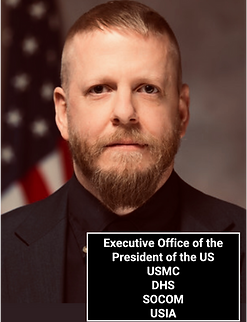
Dr. Howard Gambrill Clark
Professor Gambrill Clark has specialized in influence strategies and psychological warfare for 27 years. He graduated from Yale University with a degree in international relations focusing on the Middle East. While a student, Dr. Clark was a writer for U.S. Information Agency's Middle East / South Asia Division; served on the staff of the Senate Defense Appropriations Subcommittee; and studied Arabic at the American University in Cairo via a Department of Defense grant. After Yale, Dr. Clark served as policy analyst in the Executive Office of the President for the President’s Chief Economic Adviser, focusing on counterterrorism. Following the White House, Dr. Clark served in the U.S. Marine Corps as an intelligence officer and multi-national / special-unit commander with multiple deployments to Iraq as well as Afghanistan and the Philippines. After military service, Dr. Clark was presidentially appointed as Department of Homeland Security Chief Intelligence Officer's Special Assistant. Then, as Senior Intelligence Analyst for Homeland Security Counter-Radicalization, Dr. Clark helped lead the Intelligence Community in intelligence support to countering violent extremism. He was then promoted to Senior Intelligence Officer for Homeland Security Operations Intelligence (headquarters) before acting as consultant (contracted Senior Intelligence Analyst) to Special Operations Command's Counter-Radicalization Branch. While earning his Ph.D. from King's College London War Studies, he served as senior counter-violent-extremism adviser and trainer for USAID, USSOCOM, USDA, DOS, Special Forces, USMC, NATO, and partner governments in southwest Asia and Associate Fellow at the International Centre for the Study of Radicalisation. Recent positions includes: CEO, Stability Institute (non-profit) - training and advising special operators and stabilization professionals on defeating extremist groups throughout five continents. Faculty, National Defense College (UAE) - director and coordinator for 'Countering-Violent-Extremism,' 'Information and Cyberwarfare,' 'Media and National Security,' and 'International Security' programs (sponsored by the U.S. National Defense University) Lecturer, Civil and Political School (Ukraine) He is now the president of Narrative Strategies, where he teaches and researches the fields of strategic influence, psychological warfare, counterterrorism, and countering violent extremism. He is also an associate professor of influence strategy and psychological warfare in Washington, DC. Select books / theses: Influence Warfare Volume I: A Blueprint, Narrative Strategies Ink, Washington, DC, 2021 Information Warfare: The Lost Tradecraft, Narrative Strategies, LLC, Washington, DC, 2017 Information as an Instrument of State Power: A Primer, UAE National Defense College, UAE General Headquarters, 2017 Countering Violent Extremism: A Primer, UAE National Defense College, UAE General Headquarters, 2017 Defeating Violent Extremists: The Tradecraft, UAE National Defense College, UAE General Headquarters, 2016 Village Stability Operations, U.S. Army Peacekeeping & Stability Operations Institute, 2015 (coauthor) Lions of Marjah: Why Marjah’s Militia Combats Violent Extremists, King’s College London thesis, 2014 Revolt Against Al-Qa`ida: A Strategy to Empower Muslims and Collapse International Insurgency, Light of New Orleans Publishing, New Orleans, 2010 Narrative Analysis: Taliban, Special Operations Command, Tampa, 2010 (coauthor) Kill Al Qaeda, Light of New Orleans Publishing, New Orleans, 2009 Select articles and chapters: "War and Narrative," chapter in Dangerous Narratives: Warfare, Strategy, Statecraft, Narrative Strategies Ink, 2020. "How to Teach Influence: Thoughts on a New Discipline," article in Teaching Public Diplomacy and the Information Instruments of Power in a Complex Media Environment, National War College and U.S. Advisory Commission on Public Diplomacy, Washington, DC 2020. “Money and Stabilization,” National Defense Journal, National Defense College, UAE, June 2017 “The Responsibility to Protect in the Context of State-Sponsored Terror,” Defense and Intelligence Norway,” July 2016 (coauthor) “Go Local,” American Interest, July/August 2015 “Regimental Effects Operations Center: Enhancing Situational Awareness and Achieving Unity of Effort in Nonkinetics,” The Marine Corps Gazette, Volume 96, Issue 8, 2012 (supporting author) “Ending Al Qaeda,” American Interest, Volume 6, Number 6, July/August 2011 (coauthor) “The Accidental Ideologue,” Jane's Terrorism and Security Monitor, 2010 Twenty-eight classified or official-use-only cross-Intelligence-Community strategic assessments on countering al-Qa`ida for cabinet-level leaders and White House, 2007 – 2009 Three National Economic Council damage assessments for potential biological terrorist attacks, 2001 Six articles on Middle East leadership and Iraqi resistance for Department of State, 1999.