

Open-source intelligence has never been more essential—or more misunderstood. In a world saturated with publicly available data, social media, commercial imagery, news reporting, government records, and AI-generated content, access to information is no longer the central challenge. The challenge is determining what matters, evaluating what can be trusted, identifying patterns across fragmented reporting, and transforming incomplete information into intelligence that reduces uncertainty for decision-makers. As governments, militaries, corporations, and non-state actors increasingly operate in a fast-moving and contested information environment, OSINT has become a critical capability for anticipating threats, understanding emerging developments, and supporting decisions with speed, rigor, and confidence. Mastering OSINT therefore requires far more than searching the internet—it requires disciplined intelligence analysis, defensible judgment, and the ability to communicate what decision-makers need to know.
This executive program immerses students in the complete process of transforming raw information into actionable intelligence. Across eight integrated modules, participants learn to distinguish information, reporting, analysis, and intelligence; process large volumes of multi-source reporting; evaluate and manage sources; apply deductive and inductive coding; and identify patterns, trends, anomalies, and significant developments. Students develop competing hypotheses, challenge assumptions, recognize intelligence gaps, distinguish correlation from causation, and refine their assessments as new evidence emerges. They then advance from analytical explanations to defensible intelligence judgments, applying professional estimative language, likelihood assessments, and confidence levels while evaluating the operational and strategic implications of their findings. This progression develops not only technical proficiency, but the analytical discipline and intellectual judgment required to produce intelligence that can withstand scrutiny.
The program also teaches students how to transform rigorous analysis into professional intelligence products that drive action. Participants learn to write effective BLUFs, executive summaries, key judgments, and complete intelligence briefs and assessments structured for clarity, transparency, and executive usability. They strengthen their ability to brief senior decision-makers with confidence, respond to analytical challenges, defend their judgments with evidence, and adapt their communication to different operational priorities and time constraints. Through cumulative exercises, iterative instructor feedback, and a final executive briefing, each participant produces a portfolio-quality intelligence assessment demonstrating proficiency across the full intelligence workflow—from organizing raw information and identifying patterns to delivering intelligence that informs strategic decisions. Students also receive access to Glocal, a professional open-source intelligence platform that supports research, analysis, collaboration, and continued professional development beyond the classroom.
What is often reserved for military, intelligence, and national-security professionals is offered here in an unclassified, rigorous, and practice-centered format accessible to civilian and international participants. Graduates emerge with far more than knowledge of OSINT tools: they learn to think like intelligence analysts, develop defensible judgments, and communicate with executive credibility. As the program’s culminating product, each student produces a professional intelligence assessment that demonstrates their ability to transform complex, fragmented open-source information into clear judgments, implications, and decision-relevant intelligence. Students then formally brief and defend their assessment before instructors and peers acting as senior decision-makers. The completed assessment serves as a portfolio-quality demonstration of the graduate’s ability to turn an overwhelming information environment into strategic understanding and informed action.
Individuals Interested In:
-
Intelligence, Defense & Policy
-
National Security
-
Private Sector & Business Intelligence
Employers do not need more applicants who can simply find information online. They need analysts who can evaluate sources, identify what matters, organize fragmented reporting, test competing explanations, and develop defensible judgments.
This program gives participants tangible evidence of those abilities. Each participant produces a portfolio-quality intelligence assessment and gains practical experience briefing and defending their conclusions before a demanding audience.
Graduates leave with more than an interest in intelligence or familiarity with online research. They leave with a professional intelligence product they can discuss with prospective employers—and demonstrated experience applying the judgment, writing, analytical, and briefing skills expected of an OSINT analyst.
Knowing how to find information is no longer enough. What distinguishes an effective OSINT analyst is the ability to evaluate sources, uncover meaningful patterns, develop defensible judgments, and communicate intelligence that decision-makers can act upon. This program helps participants build those advanced capabilities—and demonstrate them through a portfolio-quality intelligence assessment.
1. Think Like an Intelligence Analyst
Move beyond internet research and understand OSINT as a disciplined decision-support capability. Translate decision-maker needs into focused intelligence requirements and relevant collection priorities.
Professional Advantage: Approach OSINT assignments strategically; Focus research on what matters; Reduce uncertainty for decision-makers.
2. Master Multi-Source Information
Collect, organize, verify, and evaluate information from news, social media, government records, commercial data, imagery, and other digital sources while maintaining clear source traceability.
Professional Advantage: Manage complex information environments; Recognize unreliable reporting; Produce intelligence that withstands scrutiny.
3. Find the Signal Others Miss
Identify patterns, relationships, anomalies, emerging developments, and intelligence gaps across fragmented reporting.
Professional Advantage: Separate signal from noise; Detect important developments earlier; Identify priorities for further collection.
4. Produce More Rigorous Analysis
Apply structured analytical techniques to test competing hypotheses, challenge assumptions, evaluate contradictory evidence, and recognize bias, disinformation, and deception.
Professional Advantage: Avoid premature conclusions; Reduce analytical bias; Develop stronger and more defensible explanations.
5. Turn Information into Defensible Intelligence
Synthesize evidence into clear judgments using professional estimative language, likelihood assessments, and confidence levels. Produce decision-ready products incorporating BLUFs, key judgments, supporting analysis, and relevant visualizations.
Professional Advantage: Demonstrate advanced analytical judgment; Communicate uncertainty precisely; Deliver intelligence leaders can use.
6. Brief, Defend, and Demonstrate Your Expertise
Present and defend intelligence assessments before simulated senior decision-makers while using AI responsibly to support research, analysis, and production without sacrificing verification or human judgment.
Professional Advantage: Communicate with executive credibility; Defend conclusions under scrutiny; Use AI as an analytical advantage—not a substitute for expertise.
Stand Out With Demonstrated OSINT Experience
Participants complete a portfolio-quality intelligence assessment and formally brief and defend their findings. This culminating product provides tangible evidence of their ability to manage the complete OSINT workflow—from fragmented open-source reporting to defensible judgments and decision-relevant intelligence.
Graduates leave prepared not merely to conduct OSINT research, but to stand out as disciplined analysts who can think critically, exercise sound judgment, and produce intelligence that informs action.


Dr. Elena Taube Bailey

Dr. Bailey brings a wealth of expertise spanning intelligence, policy, defense, and academia, as well as the nonprofit and private sectors. In academia, Dr. Bailey serves as the President and Program Director of Cyberpsychology at The Academy. Additionally, Dr. Bailey is a professor at the National Defense University’s College of Information and Cyberspace (CIC), where she teaches courses on influence warfare, cyberspace, national security, and strategic communication. She also holds the position of Adjunct Professor at Georgetown University, within the Master of Professional Studies in Applied Intelligence program. Dr. Bailey is the co-founder and CEO of Glocal, the world’s pioneering News Superintelligence platform, combining human collective intelligence and AI to elevate the information environment. Fluent in English, Russian, Ukrainian, and conversational Hebrew, Dr. Bailey resides in the Washington Metropolitan Area with her husband. Counterintelligence & Intelligence: Dr. Bailey served as a senior counterintelligence (CI) specialist at the Department of Defense, Defense Threat Reduction Agency (DTRA), where she focused on CI and worldwide cyber threat analysis. DTRA enables the DoD and the U.S. Government to prepare for and combat WMDs and improvised threats and to ensure nuclear deterrence. The agency’s legacy extends back to the Manhattan Engineering Project that was created to develop the world’s first atomic bomb during World War II. Prior to DTRA, Dr. Bailey served as a senior CI analyst at the Office of the Director of National Intelligence (ODNI), the National Counterintelligence and Security Center (NCSC), where she supported joint CI operations and led a program that drove intelligence integration and collaboration across the intelligence community (IC). During this time, Dr. Bailey also served as a Regional Subject Matter Expert (SME) to the DoD, Department of the Army, focusing on geographic, economic, industry, political, security, and geopolitical issues in Ukraine. Before her tenure at the Office of the Director of National Intelligence (ODNI), Dr. Bailey served as an Intelligence Analyst at the Central Intelligence Agency (CIA), where she collaborated closely with operations on counterterrorism initiatives. Additionally, Dr. Bailey successfully completed a rotation with the U.S. Department of State’s Center for Strategic Counterterrorism Communications where she specialized in developing and executing overt counterterrorism messaging operations. Foreign Governments: Between 2006 and 2007, Dr. Bailey provided political and media analysis, as well as, conducted public relations and strategic communication at the Consulate General of Israel in Los Angeles, and the Consulate General of Ukraine in San Francisco. Local Government & Politics: In 2009, Dr. Bailey served as a Legislative Deputy Assistant to Councilman Greig Smith, who was succeeded by Councilman Mitchell Englander, at the Los Angeles City Hall, Council District 12, representing the San Fernando Valley. More specifically, Dr. Bailey developed and maintained relationships between the district office and the diverse constituents in District 12. She also managed public relations with local, state and federal bodies, organizations, and the LA Joint Terrorism Taskforce (JTTF)—a partnership between the FBI and other law enforcement agencies charged with countering terrorism. Between 2004 and 2005, Dr. Bailey worked as a Presidential Campaign Coordinator in Fremont, CA. Then in 2007, she went on to serve as the Field Manager of California Region 3, for a presidential candidate. Education: Dr. Bailey completed a Ph.D. in Strategic Communication from George Mason University. She received a Masters Degree in Psychology from Harvard University and an M.B.A. from Georgetown University, McDonough School of Business with a focus in marketing, strategy and management. She had also received a Masters Degree in Politics with a focus in International Relations and American Government from New York University (NYU). Additionally, Dr. Bailey holds a Certificate in Intelligence Analysis from the Sherman Kent school for Intelligence Analysis, which is a training school for CIA intelligence analysts, a Graduate Certificate in Advanced Marketing Management from Georgetown University, and a Graduate Certificate in Messianic Jewish Studies from the Messianic Jewish Theological Institute. Dr. Bailey had pursued her undergraduate studies at Harvard University, the Hebrew University of Jerusalem, and UCLA where she graduated with honors and earned a B.A. in Political Science with a focus in International Relations and a minor in Middle Eastern Studies.
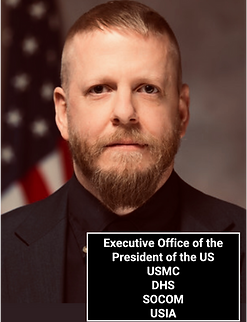
Dr. Howard Gambrill Clark
Professor Gambrill Clark has specialized in influence strategies and psychological warfare for 27 years. He graduated from Yale University with a degree in international relations focusing on the Middle East. While a student, Dr. Clark was a writer for U.S. Information Agency's Middle East / South Asia Division; served on the staff of the Senate Defense Appropriations Subcommittee; and studied Arabic at the American University in Cairo via a Department of Defense grant. After Yale, Dr. Clark served as policy analyst in the Executive Office of the President for the President’s Chief Economic Adviser, focusing on counterterrorism. Following the White House, Dr. Clark served in the U.S. Marine Corps as an intelligence officer and multi-national / special-unit commander with multiple deployments to Iraq as well as Afghanistan and the Philippines. After military service, Dr. Clark was presidentially appointed as Department of Homeland Security Chief Intelligence Officer's Special Assistant. Then, as Senior Intelligence Analyst for Homeland Security Counter-Radicalization, Dr. Clark helped lead the Intelligence Community in intelligence support to countering violent extremism. He was then promoted to Senior Intelligence Officer for Homeland Security Operations Intelligence (headquarters) before acting as consultant (contracted Senior Intelligence Analyst) to Special Operations Command's Counter-Radicalization Branch. While earning his Ph.D. from King's College London War Studies, he served as senior counter-violent-extremism adviser and trainer for USAID, USSOCOM, USDA, DOS, Special Forces, USMC, NATO, and partner governments in southwest Asia and Associate Fellow at the International Centre for the Study of Radicalisation. Recent positions includes: CEO, Stability Institute (non-profit) - training and advising special operators and stabilization professionals on defeating extremist groups throughout five continents. Faculty, National Defense College (UAE) - director and coordinator for 'Countering-Violent-Extremism,' 'Information and Cyberwarfare,' 'Media and National Security,' and 'International Security' programs (sponsored by the U.S. National Defense University) Lecturer, Civil and Political School (Ukraine) He is now the president of Narrative Strategies, where he teaches and researches the fields of strategic influence, psychological warfare, counterterrorism, and countering violent extremism. He is also an associate professor of influence strategy and psychological warfare in Washington, DC. Select books / theses: Influence Warfare Volume I: A Blueprint, Narrative Strategies Ink, Washington, DC, 2021 Information Warfare: The Lost Tradecraft, Narrative Strategies, LLC, Washington, DC, 2017 Information as an Instrument of State Power: A Primer, UAE National Defense College, UAE General Headquarters, 2017 Countering Violent Extremism: A Primer, UAE National Defense College, UAE General Headquarters, 2017 Defeating Violent Extremists: The Tradecraft, UAE National Defense College, UAE General Headquarters, 2016 Village Stability Operations, U.S. Army Peacekeeping & Stability Operations Institute, 2015 (coauthor) Lions of Marjah: Why Marjah’s Militia Combats Violent Extremists, King’s College London thesis, 2014 Revolt Against Al-Qa`ida: A Strategy to Empower Muslims and Collapse International Insurgency, Light of New Orleans Publishing, New Orleans, 2010 Narrative Analysis: Taliban, Special Operations Command, Tampa, 2010 (coauthor) Kill Al Qaeda, Light of New Orleans Publishing, New Orleans, 2009 Select articles and chapters: "War and Narrative," chapter in Dangerous Narratives: Warfare, Strategy, Statecraft, Narrative Strategies Ink, 2020. "How to Teach Influence: Thoughts on a New Discipline," article in Teaching Public Diplomacy and the Information Instruments of Power in a Complex Media Environment, National War College and U.S. Advisory Commission on Public Diplomacy, Washington, DC 2020. “Money and Stabilization,” National Defense Journal, National Defense College, UAE, June 2017 “The Responsibility to Protect in the Context of State-Sponsored Terror,” Defense and Intelligence Norway,” July 2016 (coauthor) “Go Local,” American Interest, July/August 2015 “Regimental Effects Operations Center: Enhancing Situational Awareness and Achieving Unity of Effort in Nonkinetics,” The Marine Corps Gazette, Volume 96, Issue 8, 2012 (supporting author) “Ending Al Qaeda,” American Interest, Volume 6, Number 6, July/August 2011 (coauthor) “The Accidental Ideologue,” Jane's Terrorism and Security Monitor, 2010 Twenty-eight classified or official-use-only cross-Intelligence-Community strategic assessments on countering al-Qa`ida for cabinet-level leaders and White House, 2007 – 2009 Three National Economic Council damage assessments for potential biological terrorist attacks, 2001 Six articles on Middle East leadership and Iraqi resistance for Department of State, 1999.